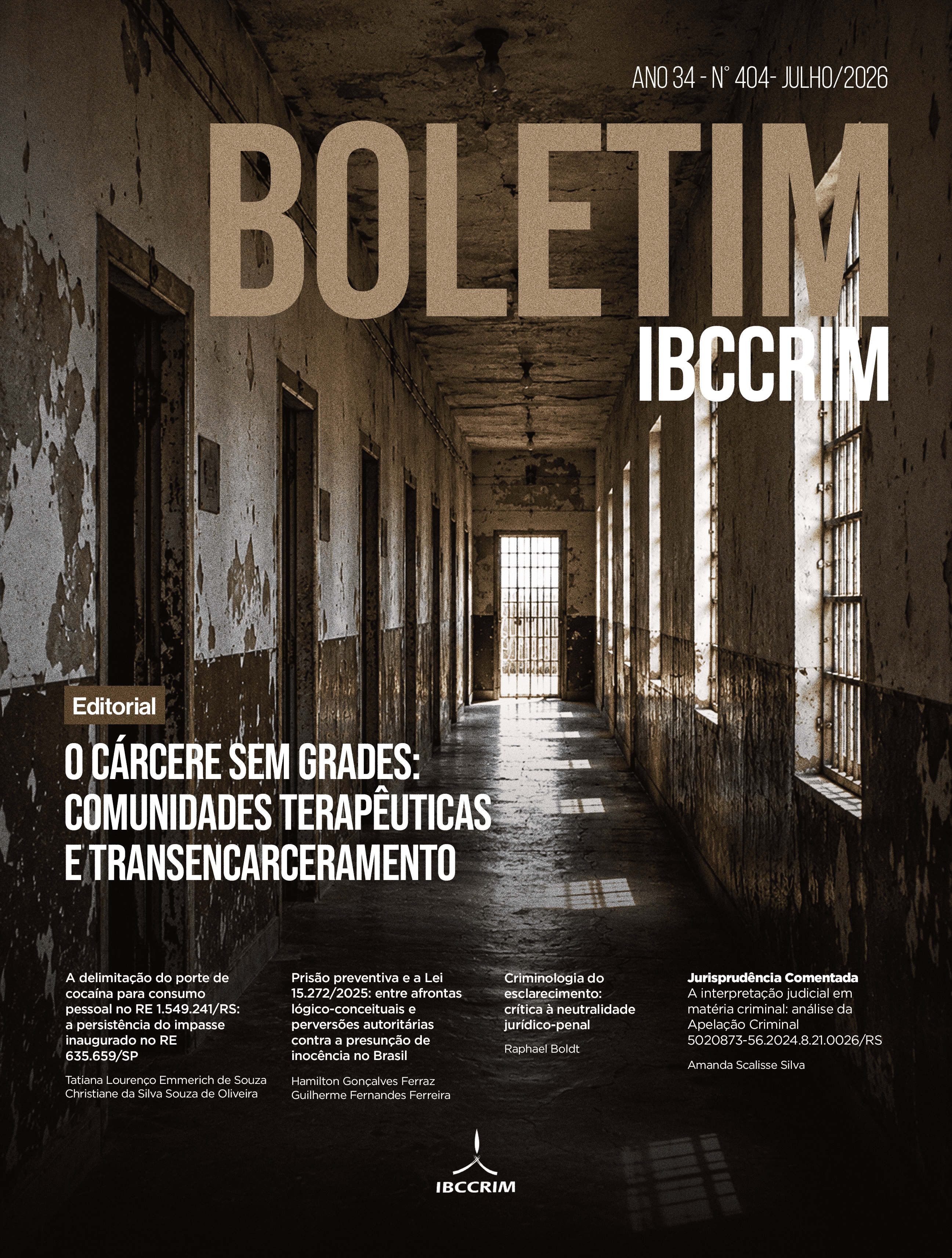
The prison without bars
therapeutic communities and transincarceration
DOI:
https://doi.org/10.5281/zenodo.20814324Keywords:
transcarceration, mass incarceration, electronic monitoring, therapeutic communitiesAbstract
In 2008, the seminar “Depois do Grande Encarceramento” (After the Great Incarceration) sought to understand and overcome the surge of imprisonment in Brazil. Almost two decades later, this editorial argues that the phenomenon now intensifying and reshaping that surge is transcarceration—the expansion of punitive logic through institutions that present themselves as alternatives to prison. Drawing on Alessandro De Giorgi, it contends that the Brazilian case differs fundamentally from that of the United States: whereas California was court-ordered to reduce its prison population in Brown v. Plata (2011), Brazil not only widens the carceral net but produces an exponential increase in electronic monitoring—from 6,027 people in 2016 to 129,810 in 2025—while shifting or expanding confinement into therapeutic communities that operate without judicial oversight, despite the deinstitutionalization initiated by Resolution 487/2023 of the National Council of Justice.
Downloads
References
ABRAMOVAY, Pedro; BATISTA, Vera Malaguti (org.). Depois do grande encarceramento: seminário. Rio de Janeiro: Revan, 2010.
BRASIL. Lei nº 10.216, de 6 de abril de 2001. Dispõe sobre a proteção e os direitos das pessoas portadoras de transtornos mentais e redireciona o modelo assistencial em saúde mental. Brasília: Presidência da República, 2001. Disponível em: https://www.planalto.gov.br/ccivil_03/leis/leis_2001/l10216.htm. Acesso em: 19 jun. 2026.
BRASIL. Ministério da Justiça e Segurança Pública. Secretaria Nacional de Políticas Penais (Senappen). Levantamento Nacional de Informações Penitenciárias (Sisdepen): população em cumprimento de pena — período de referência: 2º semestre de 2025. Brasília: Senappen, 2025. Disponível em: https://www.gov.br/senappen/pt-br/servicos/sisdepen. Acesso em: 19 jun. 2026.
COHEN, Stanley. Visions of social control: crime, punishment and classification. Cambridge: Polity Press, 1985.
CONSELHO FEDERAL DE PSICOLOGIA (CFP). O pior do pior: campanha pelo fim dos manicômios judiciários. [Brasília]: CFP, [2011]. Disponível em: https://site.cfp.org.br/campanhas/pior-do-pior/. Acesso em: 19 jun. 2026.
CONSELHO FEDERAL DE PSICOLOGIA; MECANISMO NACIONAL DE PREVENÇÃO E COMBATE À TORTURA; PROCURADORIA FEDERAL DOS DIREITOS DO CIDADÃO/MPF. Relatório da inspeção nacional em comunidades terapêuticas – 2017. Brasília: CFP, 2018.
CONSELHO NACIONAL DE JUSTIÇA (CNJ). Resolução nº 487, de 15 de fevereiro de 2023. Institui a Política Antimanicomial do Poder Judiciário e dá outras providências. Brasília: CNJ, 2023.
COSTA, Pedro Henrique Antunes da; LEMOS, Carolina Barreto. As comunidades terapêuticas em evidência: o que dizem as avaliações e fiscalizações do estado brasileiro? Brasília: Mecanismo Nacional de Prevenção e Combate à Tortura; Grupo Psicologia e Ladinidades, 2025. Disponível em: https://mnpctbrasil.wordpress.com/wp-content/uploads/2025/03/cts-em-evidencia_corrigido.pdf. Acesso em: 19 jun. 2026.
DAL SANTO, Luiz Phelipe. Cumprindo pena no Brasil: encarceramento em massa, prisão-depósito e os limites das teorias sobre giro punitivo na realidade periférica. Revista Brasileira de Ciências Criminais, São Paulo, v. 151, n. 27, p. 291-315, 2019.
DE GIORGI, Alessandro. Cinco teses sobre o encarceramento em massa. Tradução de Leandro Ayres França. Porto Alegre: Canal Ciências Criminais, 2017.
ESTADOS UNIDOS. Suprema Corte. Brown, et al. v. Plata, et al., 563 U.S. 493 (2011). Decided: May 23, 2011. Disponível em: https://supreme.justia.com/cases/federal/us/563/493/. Acesso em: 19 jun. 2026.
MECANISMO NACIONAL DE PREVENÇÃO E COMBATE À TORTURA (MNPCT). Ação do MNPCT e da Defensoria Pública resgata 52 mulheres mantidas ilegalmente em uma comunidade terapêutica em Guarulhos. MNPCT, Brasília, 16 jun. 2026. Disponível em: https://mnpctbrasil.wordpress.com/2026/06/16/acao-do-mnpct-e-da-defensoria-publica-resgata-52-mulheres-mantidas-ilegalmente-em-uma-comunidade-terapeutica-em-guarulhos/. Acesso em: 19 jun. 2026.
PINTO, Nataly Isabelle Pessoa da Silva; LIRA, Terçália Suassuna Vaz. O surgimento e a expansão das comunidades terapêuticas no Brasil. Revista Direitos Sociais e Políticas Públicas (Unifafibe), v. 13, n. 2, p. 168-197, 2025. https://doi.org/10.25245/rdspp.v13i2.1717
SILVA, Laura Fernandes da. Paradoxo do cuidado: segregação e controle institucional de pessoas usuárias de álcool e outras drogas na região metropolitana de Maceió. 2022. Dissertação (Mestrado em Direito) – Universidade Federal de Alagoas, Maceió, 2022.
Downloads
Published
How to Cite
Issue
Section
License

This work is licensed under a Creative Commons Attribution-NonCommercial 4.0 International License.
Copyright of published articles belongs to the author, but with journal rights over the first publication and respecting the one-year exclusivity period. Authors may only use the same results in other publications by clearly indicating this journal as the medium of the original publication. If there is no such indication, it will be considered a situation of self-plagiarism.
Therefore, the reproduction, total or partial, of the articles published here is subject to the express mention of the origin of its publication in this journal, citing the volume and number of this publication. For legal purposes, the source of the original publication must be consigned, in addition to the DOI link for cross-reference (if any).