About the Journal
The Instituto Brasileiro de Ciências Criminais IBCCRIM Bulletin is a monthly scientific publication of the Instituto Brasileiro de Ciências Criminais, continuously published since 1993, in both print and digital formats, and made available through open access, without submission or article processing charges. Dedicated to the fields of Criminal Law, Criminal Procedure, Criminology, and Human Rights, the journal publishes qualified academic reflections, critical analyses of criminal policy, and annotated case law, articulating scientific production, institutional debate, and judicial practice.
With double-blind peer review, editorial regularity, institutional identification through ROR, print and electronic ISSN, as well as indexing in databases and directories such as Google Scholar, Directory of Open Access Journals, MIAR, BASE, ERIH PLUS, OASISBR, Latindex, LatinREV, Sumários.org, ROAD, OpenAlex, and international library presence through WorldCat, the IBCCRIM Bulletin brings together attributes characteristic of high-quality scholarly journals, expanding the visibility, reliability, and reach of its scientific output.
Taken as a whole, the IBCCRIM Bulletin has consolidated itself as a leading editorial space for legal and criminological critique, committed to democracy, the restraint of punitive power, the promotion of fundamental rights, and the strengthening of dialogue among research, advocacy, the judiciary, the justice system, and civil society. It is therefore a publication devoted not only to scientific dissemination, but also to fostering a critical, plural, and socially committed legal culture.
Current Issue
Vol. 34 No. 408 (2026): Boletim IBCCRIM - Novembro
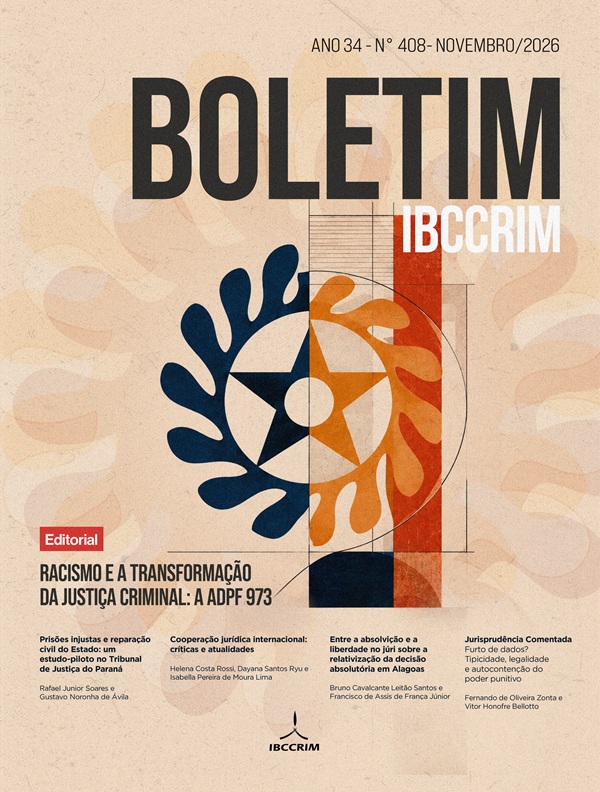
O Boletim IBCCRIM é uma publicação de periodicidade mensal, em circulação desde 1993, que apresenta aos associados e às associadas do Instituto Brasileiro de Ciências Criminais trabalhos de grande relevância sobre temas atuais de Direito Penal, Direito Processual Penal, Criminologia e Direitos Humanos, bem como traz uma coletânea de jurisprudência dos tribunais pátrios concernentes às ciências criminais.
Published:
2026-10-23