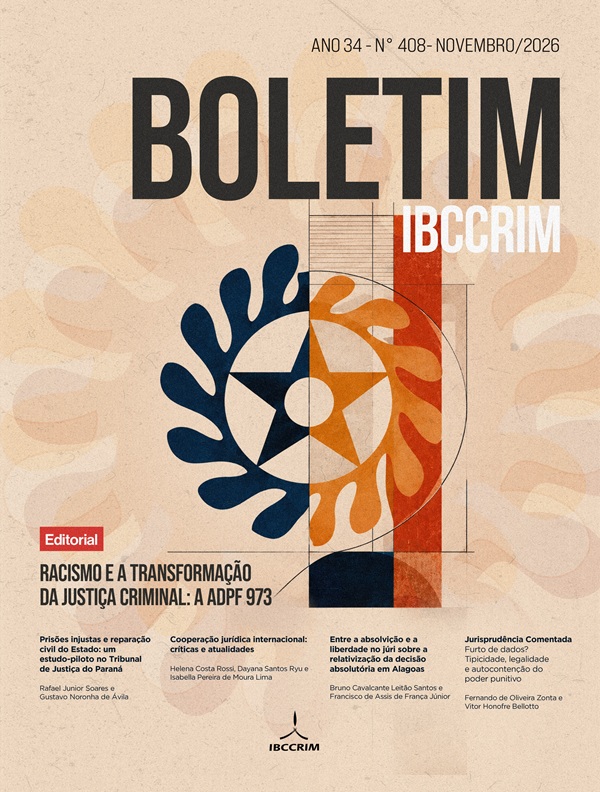
Data theft?
Criminal typicity, legality, and the self-restraint of punitive power
DOI:
https://doi.org/10.5281/zenodo.23196195Keywords:
Theft, Digital documents, Criminal non-liability, Legality in criminal law, In malam partem analogyAbstract
The article examines whether the unauthorized copying of confidential digital documents constitutes theft under Article 155 of the Brazilian Penal Code. The analysis addresses the concept of taking, the requirement of patrimonial loss, and the limits of interpretation in criminal law. The Superior Court of Justice held that reproducing documents does not constitute taking, since the originals remain within the victim’s sphere of possession and availability, without any loss of assets. Although acknowledging the seriousness and reprehensibility of the conduct, the Court ruled that it does not constitute a criminal offense, based on the principle of strict legality and the prohibition of in malam partem analogy.
Downloads
References
FERRAJOLI, Luigi. Direito e Razão. São Paulo: Thomson Reuters, 2014.
GRECO, Luís. Um panorama da teoria da imputação objetiva. São Paulo: Revista dos Tribunais, 2014.
ROXIN, Claus; GRECO, Luís. Direito penal: parte geral: tomo I: fundamentos: a estrutura da teoria do crime - São Paulo: Marcial Pons, 2024.
Downloads
Published
How to Cite
Issue
Section
License

This work is licensed under a Creative Commons Attribution-NonCommercial 4.0 International License.
Copyright of published articles belongs to the author, but with journal rights over the first publication and respecting the one-year exclusivity period. Authors may only use the same results in other publications by clearly indicating this journal as the medium of the original publication. If there is no such indication, it will be considered a situation of self-plagiarism.
Therefore, the reproduction, total or partial, of the articles published here is subject to the express mention of the origin of its publication in this journal, citing the volume and number of this publication. For legal purposes, the source of the original publication must be consigned, in addition to the DOI link for cross-reference (if any).