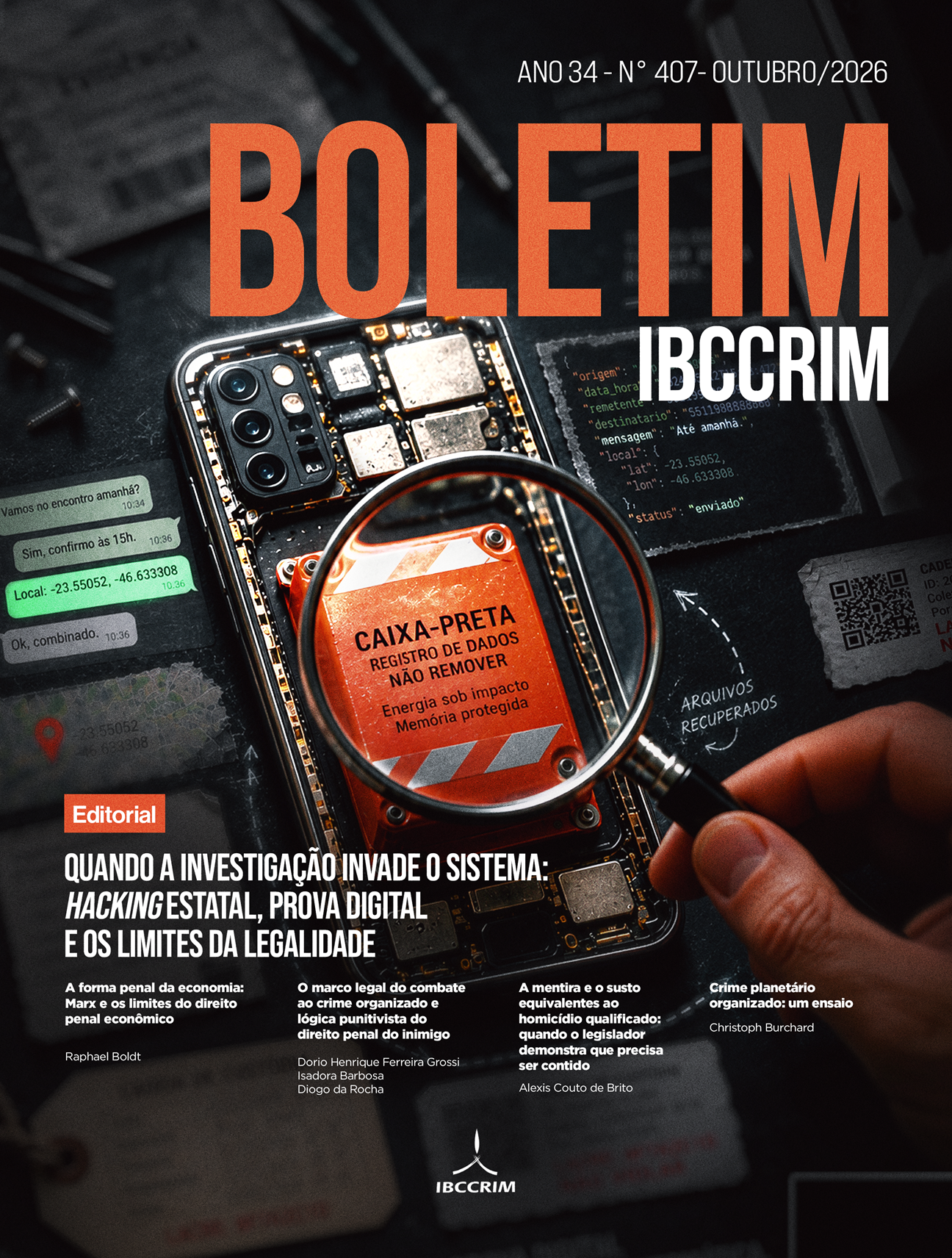
The lie and the fright equivalent to qualified homicide
when the legislator demon-strates that it needs to be contained
DOI:
https://doi.org/10.5281/zenodo.22921980Keywords:
Anticriminal Organization Law, Raul Jungmann Law, ultraviolent crimeAbstract
The article criticizes excessive Brazilian criminal legislative production and examines Law 15,358/26, which established the Legal Framework for Combating Organized Crime. The exposition argues that the law challenges dogmatics and democratic criminal policy by criminalizing lies and fright as heinous crimes, equating them with qualified homicide. The text analyzes the criminal type of article 3, VI, which punishes falsely claiming to belong to an ultraviolent criminal organization, and presents dogmatic and criminalpolicy criticisms, invoking Ferrajoli, the reservation of code, and proportionality. The investigation concludes with the manifest unconstitutionality of the provision.
Downloads
References
BRASIL. Lei nº 15.358, de 24 de março de 2026. Institui o Marco Legal do Combate ao Crime Organizado no Brasil (Lei Raul Jungmann) […]. Brasília: Presidência da República, 2026. Disponível em: https://www.planalto.gov.br/ccivil_03/_ato2023-2026/2026/lei/l15358.htm. Acesso em: 21 set. 2026.
BRITO, Alexis Couto de. Elementos subjetivos do tipo e “crime” formal: uma revisão crítica a partir da linguagem. In: ROCHA, Fernando A. N. Galvão da; BUSATO, Paulo César (org.). Direito penal, neurociência e linguagem. Anais do III Congresso Ibero-americano de Direito penal e Filosofia da linguagem. Porto Alegre: Editora FI, 2020.
FERRAJOLI, Luigi. Principia iuris: Teoria del diritto e della democrazia. 2. Teoria della democrazia. Bari: Laterza, 2007.
FERRAJOLI, Luigi. Direito e razão: Teoria do garantismo penal. 3. ed. rev. Tradução: Ana Paula Zomer Sica et al. Colaboração: Alexis Couto de Brito et al. São Paulo: Revista dos Tribunais, 2010.
Downloads
Published
How to Cite
Issue
Section
License
Copyright (c) 2026 Alexis Couto de Brito

This work is licensed under a Creative Commons Attribution-NonCommercial 4.0 International License.
Copyright of published articles belongs to the author, but with journal rights over the first publication and respecting the one-year exclusivity period. Authors may only use the same results in other publications by clearly indicating this journal as the medium of the original publication. If there is no such indication, it will be considered a situation of self-plagiarism.
Therefore, the reproduction, total or partial, of the articles published here is subject to the express mention of the origin of its publication in this journal, citing the volume and number of this publication. For legal purposes, the source of the original publication must be consigned, in addition to the DOI link for cross-reference (if any).