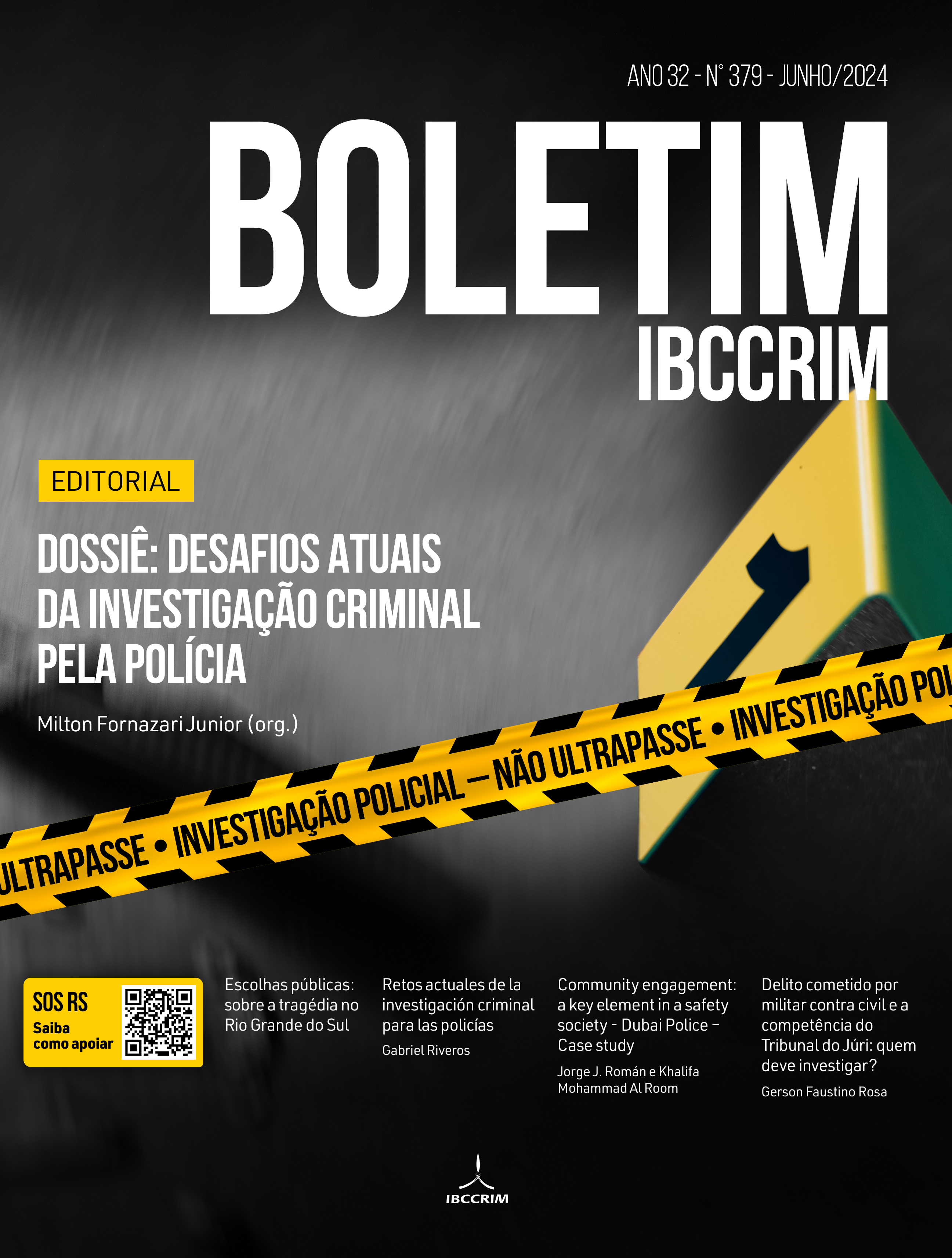
O envolvimento da comunidade é um elemento fundamental para uma sociedade segura Polícia de Dubai – estudo de caso
DOI:
https://doi.org/10.5281/zenodo.11175692Palavras-chave:
Community engagement, Accountability, Public Sector, Dubai PoliceResumo
A cooperação da população em Dubai é um elemento fundamental para prevenir o crime. Em termos simples, o serviço policial deixaria de funcionar sem o apoio ativo das comunidades que serve. As evidências mostram que o envolvimento eficaz da comunidade, patrulhas a pé direcionadas e a resolução colaborativa de problemas podem aumentar significativamente a confiança do público nas atividades policiais. O policiamento por consentimento requer o apoio público às atividades policiais em todos os níveis. O objetivo do envolvimento, bem como o nível em que as pessoas e as comunidades devem se envolver, deve ser claro. O envolvimento da comunidade produz dois benefícios principais: melhoria na tomada de decisões e aumento da cidadania. A Polícia de Dubai se concentra principalmente no benefício da tomada de decisões do envolvimento da comunidade e no aumento dos níveis de confiança e satisfação com o policiamento em nível individual. Uma iniciativa de envolvimento da comunidade é um componente crítico de qualquer atividade policial eficaz. Ela exige que vários atores-chave trabalhem em estreita colaboração para desenvolver programas e iniciativas eficazes para governar suas operações. O envolvimento eficaz é mais do que organizar uma reunião com membros da comunidade. É um processo rigoroso que exige sensibilidade e planejamento e execução cuidadosos. Desde 2000, a Polícia de Dubai tem trabalhado em diferentes programas para aumentar o envolvimento da comunidade.
Downloads
Referências
Bond, B., & Gabriele, K. (2018). Research and planning units: An innovation instrument in the 21st Century police organization. Criminal Justice Policy Review, 29, 67–88.
Blaug R, Horner L and Lekhi R. (2006) Public Value, Citizen Expectations and User Commitment, London, The Work Foundation
Cameron K, & Ettington D. (1988), “The conceptual foundations of organizational culture”, In John Smart (Ed.) Higher Education: Handbook of Theory and Research, New York: Agathon, pp. 356- 396.
Chan, J. (2001). The Technology game: How information technology is transforming police practice. Journal of Criminal Justice, 1, 139-159.
College of Policing. (2013). Engagement and communication. Retrieved from https://www.app.college.police.uk/app-content/engagement- andcommunication/engaging-with-communities
Docobo, J. (2005). Community policing as the primary prevention strategy for homeland security at the local law enforcement level. Homeland Security Affairs, 14 (4). Retrieved from https://www.hsaj.org/articles/183
Emsley C., Clive H., Reinke, H. and Lévy R. (1994) Les polices au XIXe et XXe siècles: Aperçus sur les historiographies anglaise, allemande et française/ Overview of English, German and French Police History Cahiers de la Sécurité Intérieure, IHESI, Paris, No.17, 13-33.
Gallup, (2019) Global Law and Order Report International Index. Gallup USA Inc.
Hauser, J., Tellis, G. & Griffin, A. (2006). Research on innovation: a review and agenda for marketing science. Marketing Science, 25, 687–717
Hollywood J, & Winkelman Z. (2015). Improving Information-Sharing Across Law Enforcement: Why Can’t We Know? National Criminal Justice Reference Service.
Lersch, K., & Mieczkowski, T. (2005). Violent police behavior: Past, present, and future research directions. Aggression and Violent Behaviour, 10, 552–568.
Maxwell, J. (2008). Designing a qualitative study. The Sage handbook of applied social research methods: 214-253.
Matt, C., Hess, T., Benlian, A. (2015). Digital transformation strategies. Bus. Inf. Syst.
Eng.57(5),339–343. https://doi.org/10.1007/s12599-015-0401-5
Metropolitan Police (2009) Metropolitan Police Authority and Metropolitan Police Service Community Engagement Strategy 2006 – 2009, UK
Moore, M., Sparrow, M. and Spelman W. (1997). “Innovations in policing: from production lines to job shops” in Altshuler, A. and Behn, R, (Eds), Innovation in American Government.
Myhill A., (2012). Community Engagement in Policing: Lessons from the Literature. Retrieved from https://whatworks.college.police.uk/Research/Doc uments/Community_engagement_lessons.pdf
Lemon, K.,& Verhoef, P. (2016). Understanding customer experience throughhout the customer journey. Journal of Marketing, 80(6), 69-96
Peed, C. R. 2008. ‘The Community-Policing Umbrella.’ FBI Law Enforcement Bulletin, p.
https://leb.fbi.gov (retrieved 19 September 2020)
Pillay, R. & Morris, M. (2016). Changing healthcare by changing the education of its leaders: An innovation competence model. Journal of Health Administration Education, 33, 393–410.
Reichert, K. (2001). Use of information technology by law enforcement. Promising Approaches to Addressing Crime Series. University of Pennsylvania, Jerry Lee Center of Criminology, Forum on Crime and Justice.
Roberts, N. & King, P. (1996). Transforming public policy: Dynamics of policy entrepreneurship and innovation, San Francisco, CA: Jossey-Bass Incorporated Pub.
Román, J. (2019). Smart Police Station, Case Study. The Quality Management Forum, Quality Management Division. American Society for Quality. Volume 45, Number 1
Ruteere, M. and Pommerolle, M. (2003) ‘Democratizing Security or Decentralizing Repression? The Ambiguities of Community Policing in Kenya’, African Affairs pp.587-604
Skolnick J. & Bayley D. (1988). Community Policing: Issues and Practices Around the World, Washington, D.C.: Government Printing Office.
Skogan, W. G. and Steiner, L. (2004). Community Policing in Chicago Year Ten: An Evaluation of Chicago’s Alternative Policing Strategy. Chicago: Illinois Criminal Justice Information Services
Yin, R. (2009) Case Study Research: Design and Methods. SAGE Publications Ltd: London
Yin, R. (2011). Applications of case study research. Sage publications.
Yin, R. (2013). Case study research: Design and methods. Sage publications.
Downloads
Publicado
Como Citar
Edição
Seção
Licença
Copyright (c) 2024 Jorge J. Román, Khalifa Al Room

Este trabalho está licenciado sob uma licença Creative Commons Attribution-NonCommercial 4.0 International License.
Os direitos autorais dos artigos publicados são do autor, mas com direitos do periódico sobre a primeira publicação e com respeito ao período de exclusividade de um ano. Os autores somente poderão utilizar os mesmos resultados em outras publicações indicando claramente este periódico como o meio da publicação original. Se não houver tal indicação, considerar-se-á situação de autoplágio.
Portanto, a reprodução, total ou parcial, dos artigos aqui publicados fica sujeita à expressa menção da procedência de sua publicação neste periódico, citando-se o volume e o número dessa publicação. Para efeitos legais, deve ser consignada a fonte de publicação original, além do link DOI para referência cruzada (se houver).