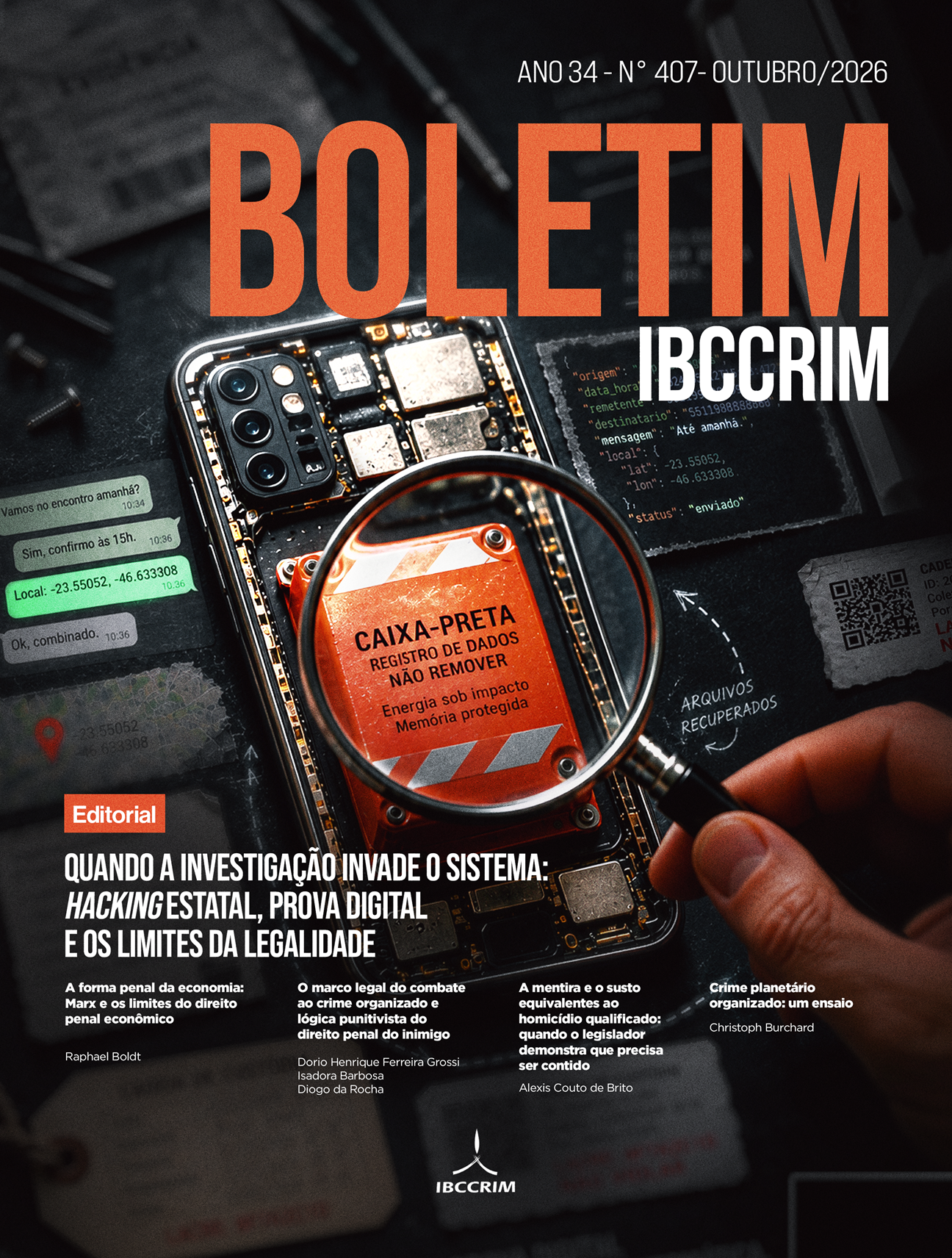
When the investigation invades the system
State hacking, digital evidence, and the limits of legality
DOI:
https://doi.org/10.5281/zenodo.22921393Keywords:
state hacking, malware, digital evidence, chain of custody, fundamental rightsAbstract
The expansion of digital investigative techniques has moved criminal prosecution beyond the seizure of physical devices toward covert and remote access to systems and data. State hacking and malware infiltration may produce substantial investigative gains, but they can also reach communications, files, cameras, microphones, and location data while altering the very environment in which evidence is generated. This editorial argues that innovation cannot operate without statutory authorization, technical transparency, effective adversarial participation, and an auditable chain of custody. The absence of a specific framework, including the regulatory gap associated with the proposed Criminal Data Protection Law, does not authorize unlimited investigative powers or decisions based on institutional trust. The article proposes concrete parameters for authorizing, conducting, preserving, and reviewing these measures, distinguishing the capacity to discover information from the legitimacy of converting it into reliable evidence.
Downloads
References
BADARÓ, Gustavo Henrique Righi ivahy. Os standards metodológicos de produção na prova digital e a importância da cadeia de custódia. Boletim IBCCRIM, São Paulo, v. 29, n. 343, p. 7-9, 2024. Disponível em: https://publicacoes.ibccrim.org.br/index.php/boletim_1993/article/view/1325. Acesso em: 21 set. 2026.
GIACOMOLLI, Nereu; CANI, Luiz Eduardo. O acesso autorizado a aparelhos smart: burla ao agente infiltrado digital?. Boletim IBCCRIM, São Paulo, v. 30, n. 352, p. 4-6, 2024. Disponível em: https://publicacoes.ibccrim.org.br/index.php/boletim_1993/article/view/1435. Acesso em: 21 set. 2026.
MASSENA, Caio Badaró. A propósito da cadeia de custódia das provas digitais no Processo Penal: breves notas sobre lógica da desconfiança, assimetria informacional e direito de defesa. Boletim IBCCRIM, São Paulo, v. 31, n. 368, p. 19-21, 2023. Disponível em: https://publicacoes.ibccrim.org.br/index.php/boletim_1993/article/view/506. Acesso em: 21 set. 2026.
NEVES, Luiz Gabriel Batista; ROSA, Hiuston César dos Santos. Tecnologia e prova digital: desafios e propostas para a cadeia de custódia no judiciário. Boletim IBCCRIM, São Paulo, v. 34, n. 398, p. 29-31, 2025. DOI: 10.5281/zenodo.17914684. Disponível em: https://publicacoes.ibccrim.org.br/index.php/boletim_1993/article/view/2654. Acesso em: 21 set. 2026.
SAAD NETTO, Cláudio; AVOLIO, Luiz Francisco Torquato; BORRI, Luiz Antonio. A cadeia de custódia da prova digital: dissensos e consensos entre teoria e práxis. Boletim IBCCRIM, São Paulo, v. 34, n. 403, p. 18-21, 2026. DOI: 10.5281/zenodo.19697006. Disponível em: https://publicacoes.ibccrim.org.br/index.php/boletim_1993/article/view/2761. Acesso em: 21 set. 2026.
Downloads
Published
How to Cite
Issue
Section
License
Copyright (c) 2026 Instituto Brasileiro de Ciências Criminais

This work is licensed under a Creative Commons Attribution-NonCommercial 4.0 International License.
Copyright of published articles belongs to the author, but with journal rights over the first publication and respecting the one-year exclusivity period. Authors may only use the same results in other publications by clearly indicating this journal as the medium of the original publication. If there is no such indication, it will be considered a situation of self-plagiarism.
Therefore, the reproduction, total or partial, of the articles published here is subject to the express mention of the origin of its publication in this journal, citing the volume and number of this publication. For legal purposes, the source of the original publication must be consigned, in addition to the DOI link for cross-reference (if any).