“Recommendations” for ordering preventive detention
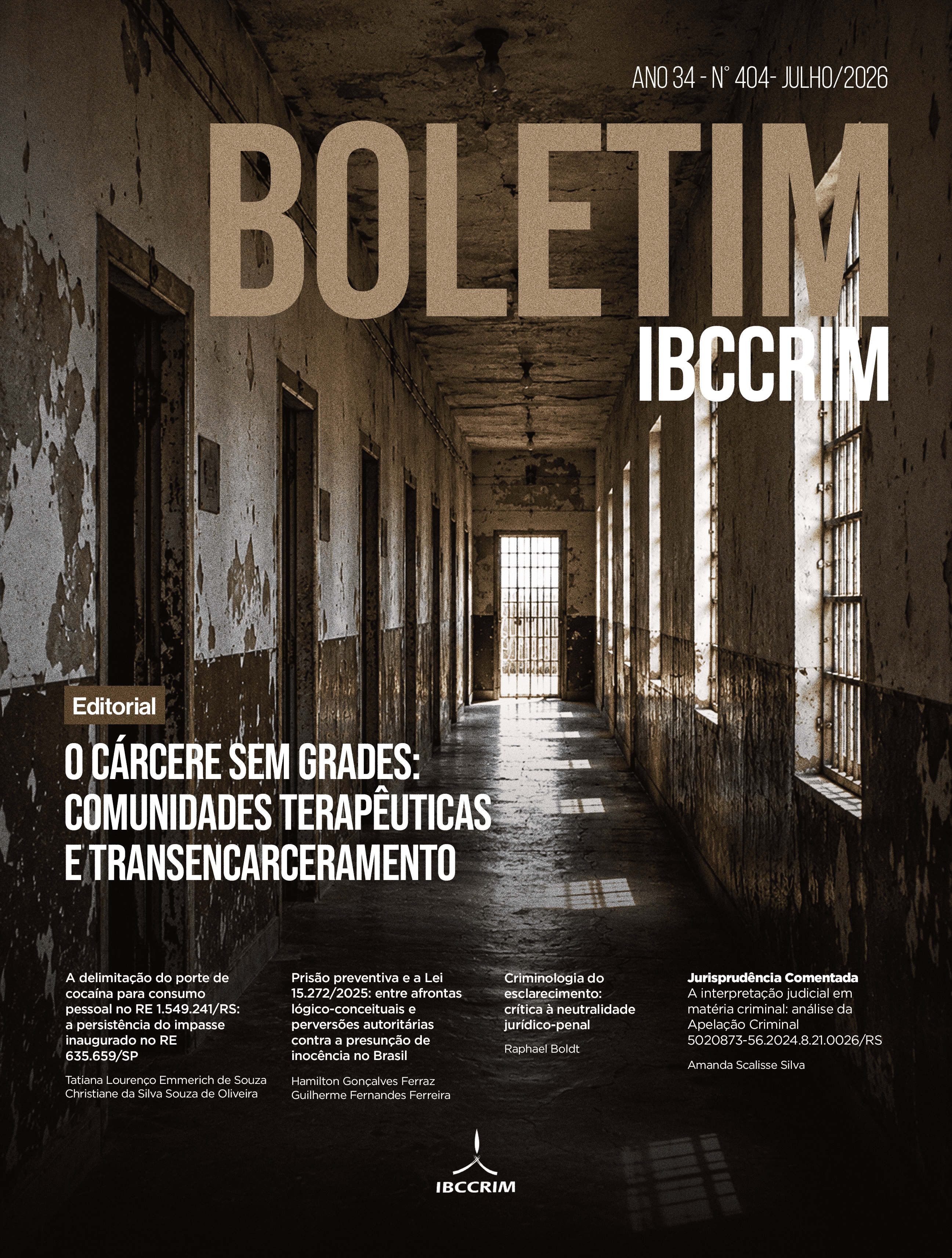
Law 15,272/25 and the weakening of the presumption of innocence
DOI:
https://doi.org/10.5281/zenodo.20815949Keywords:
Law 15,272/2025, pretrial detention, presumption of innocence, custody hearing, criminal law guaranteesAbstract
This article analyzes the impacts of Law 15,272/25 on the Brazilian criminal procedure system, focusing on the new “recommendations” for ordering preventive detention during the custody hearing. It finds that the amendment to Article 310 of the Code of Criminal Procedure weakens the principle of presumption of innocence by valuing ongoing investigations and actions as criteria for assessing dangerousness. From the perspective of penal guarantees, it concludes that the reform represents a punitive regression and a privileging of the author’s penal law, compromising the democratic and limiting function of the criminal process.
Downloads
References
BANCO NACIONAL DE MANDADOS DE PRISÃO. Brasília: Conselho Nacional de Justiça, [2026]. Disponível em: https://portalbnmp.cnj.jus.br/#/pesquisa-peca. Acesso em: 2 mar. 2026.
BRASIL. Congresso Nacional. Câmara dos Deputados. Projeto de Lei nº 226/2024. Altera o Decreto-Lei nº 3.689, de 3 de outubro de 1941 (Código de Processo Penal), para dispor sobre as circunstâncias que recomendam a conversão da prisão em flagrante em preventiva, sobre a coleta de material biológico para obtenção e armazenamento do perfil genético do custodiado e sobre os critérios para aferição da periculosidade do agente para concessão de prisão preventiva, inclusive quando da audiência de custódia. Brasília: Câmara dos Deputados, 2024. Disponível em: https://www.camara.leg.br/proposicoesWeb/fichadetramitacao?idProposicao=2456284. Acesso em: 2 mar. 2026.
BRASIL. Constituição (1988). Constituição da República Federativa do Brasil. Brasília: Presidência da República, 1988. Disponível em: https://www.planalto.gov.br/ccivil_03/constituicao/constituicao.htm. Acesso em: 15 jun. 2026.
BRASIL. Lei nº 15.272, de 26 de novembro de 2025. Altera o Decreto-Lei nº 3.689, de 3 de outubro de 1941 (Código de Processo Penal), para dispor sobre as circunstâncias que recomendam a conversão da prisão em flagrante em preventiva, sobre a coleta de material biológico para obtenção e armazenamento do perfil genético do custodiado e sobre os critérios para aferição da periculosidade do agente para concessão de prisão preventiva, inclusive quando da audiência de custódia. Brasília: Presidência da República, 2025. Disponível em: https://www.planalto.gov.br/ccivil_03/_ato2023-2026/2025/lei/l15272.htm. Acesso em: 2 mar. 2026.
CRUZ, Rogerio Schietti. Prisão cautelar: dramas, princípios e alternativas. Salvador: Juspodivm, 2021.
INSTITUTO BRASILEIRO DE CIÊNCIAS CRIMINAIS. Restrições à liberdade e à integridade física de duvidosa constitucionalidade. Boletim IBCCRIM, São Paulo, ano 34, n. 398, jan. 2026. Disponível em: https://publicacoes.ibccrim.org.br/index.php/boletim_1993/article/view/2489. Acesso em: 15 jun. 2026.
LOPES JR., Aury. Prisões cautelares. 6. ed. São Paulo: Saraiva Educação, 2021.
ORGANIZAÇÃO DOS ESTADOS AMERICANOS. Convenção Americana sobre Direitos Humanos (Pacto de São José da Costa Rica). San José, Costa Rica, 1969. Disponível em: https://www.oas.org/pt/cidh/mandato/Basicos/convencionrat.asp. Acesso em: 15 jun. 2026.
PINHO, Ana Cláudia; CHAVES, Amanda Blanco. Luigi Ferrajoli e os Fundamentos do Processo Penal Garantista. In: VILARES, Fernanda Regina (coord.). Processo penal por elas. São Paulo: D’Plácido, 2025. t. I.
PINHO, Ana Cláudia; MELCHIOR, Antonio Pedro; CASARA, Rubens. Teoria do Processo Penal Brasileiro. Rio de Janeiro: Da Vinci Livros, 2025. v. 1.
QUEIROZ, Paulo. Direito Processual Penal: Introdução. 4. ed. Salvador: Juspodivm, 2023.
ZAPATER, Maíra Cardoso. Princípios constitucionais processuais penais: um necessário critério hermenêutico. In: VILARES, Fernanda Regina (coord.). Processo penal por elas. São Paulo: D’Plácido, 2025. t. I.
Downloads
Published
How to Cite
Issue
Section
License
Copyright (c) 2026 Dra. Tainá Ferreira e Ferreira

This work is licensed under a Creative Commons Attribution-NonCommercial 4.0 International License.
Copyright of published articles belongs to the author, but with journal rights over the first publication and respecting the one-year exclusivity period. Authors may only use the same results in other publications by clearly indicating this journal as the medium of the original publication. If there is no such indication, it will be considered a situation of self-plagiarism.
Therefore, the reproduction, total or partial, of the articles published here is subject to the express mention of the origin of its publication in this journal, citing the volume and number of this publication. For legal purposes, the source of the original publication must be consigned, in addition to the DOI link for cross-reference (if any).