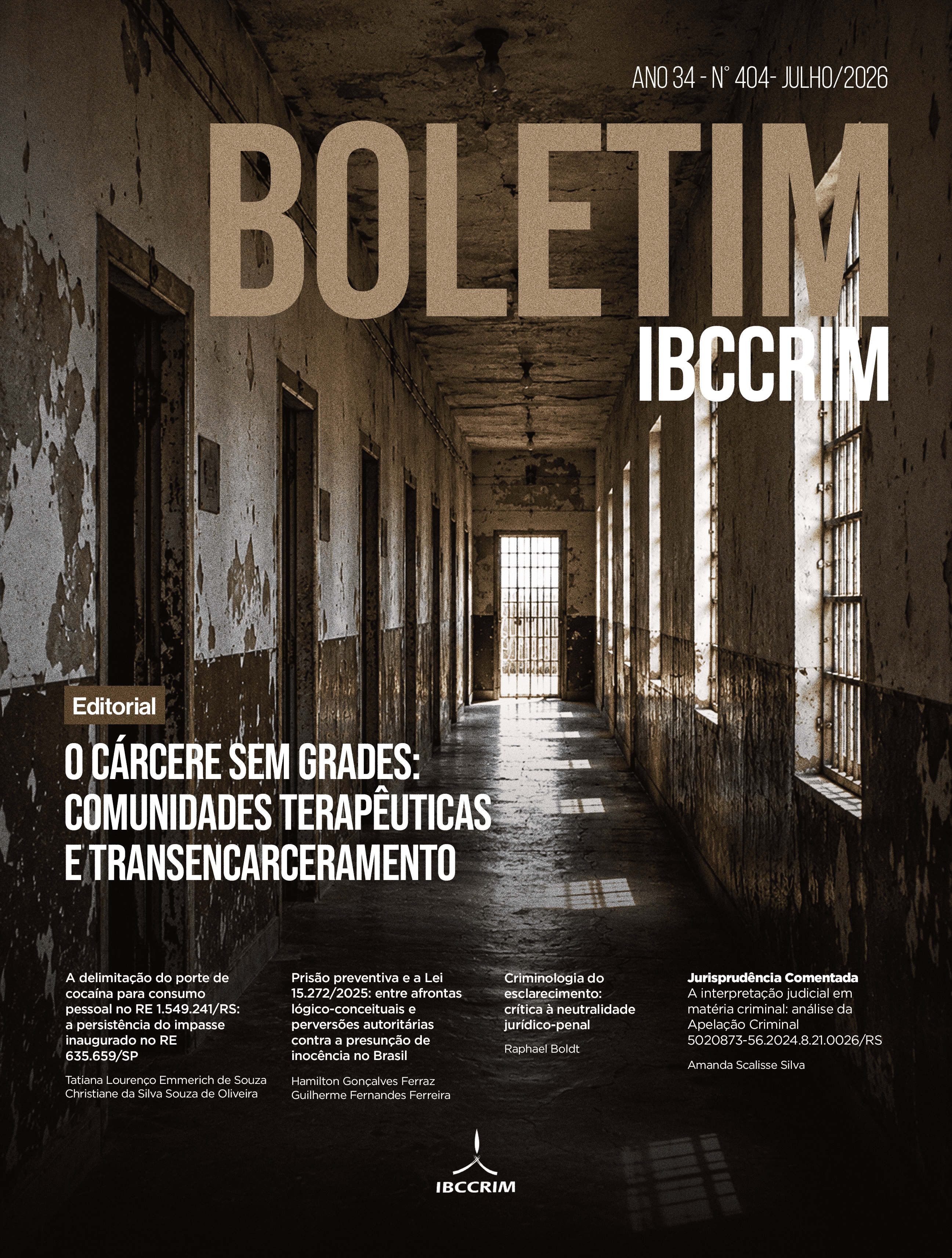
Criminology of enlightenment
critique of legal-criminal neutrality
DOI:
https://doi.org/10.5281/zenodo.20818796Keywords:
Criminal Law, critique of the method, instrumental rationality, critical theory, fundamental rightsAbstract
The article proposes a criminology of enlightenment to denaturalize the alleged penal neutrality. Drawing on Adorno and Horkheimer, it shows how the punitive reason narrows into instrumental rationality: methods and metrics come to occupy the place of justification, turning penal judgment into the efficient management of means. Mobilizing Adorno’s notion of non-identity, it argues that the “fit” between fact and legal type is never neutral and that the reification of categories and standards lowers epistemic demands. In dialogue with Marcuse, it maintains that facts have no authority on their own: they must be mediated by public ends (dignity, equality, freedom). The paper finally articulates this framework with the Brazilian criminal justice system, marked by selectivity and managerialism—and sets out guidelines to subordinate technique to justifiable purposes.
Downloads
References
ADORNO, Theodor W. Dialética negativa. Rio de Janeiro: Zahar, 2009.
ADORNO, Theodor W.; HORKHEIMER, Max. Dialética do esclarecimento. Rio de Janeiro: Zahar, 1985.
HORKHEIMER, Max. Teoria tradicional e teoria crítica. In: Textos escolhidos (Coleção Os Pensadores). São Paulo: Abril Cultural, 1980. p. 117-161.
HORKHEIMER, Max. Eclipse da razão. São Paulo: Centauro, 2002.
MARCUSE, H. Razão e revolução: Hegel e o advento da teoria social. Rio de Janeiro: Paz & Terra, 1978.
WEBER, Max. Wirtschaft und Gesellschaft. Tübingen: Winckelmann, 1964.
Downloads
Published
How to Cite
Issue
Section
License
Copyright (c) 2026 Prof. Dr. Raphael Boldt

This work is licensed under a Creative Commons Attribution-NonCommercial 4.0 International License.
Copyright of published articles belongs to the author, but with journal rights over the first publication and respecting the one-year exclusivity period. Authors may only use the same results in other publications by clearly indicating this journal as the medium of the original publication. If there is no such indication, it will be considered a situation of self-plagiarism.
Therefore, the reproduction, total or partial, of the articles published here is subject to the express mention of the origin of its publication in this journal, citing the volume and number of this publication. For legal purposes, the source of the original publication must be consigned, in addition to the DOI link for cross-reference (if any).